What Maintenance Duties Does Wisconsin Law Put on a Landlord?
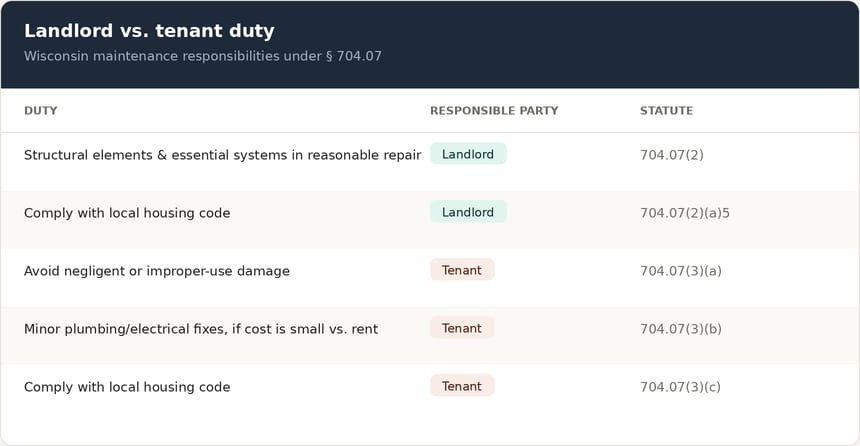
Wisconsin law requires landlords to keep structural elements and essential systems in reasonable repair under Wis. Stat. § 704.07(2). Landlords must also comply with any local housing code that applies to the rental property.
Legal jargon about maintenance can sound like a long list of big words. But Jim Miller knows there’s much more than that. Before founding Performance Asset Management (PAM), he was a dad with a son diagnosed with childhood asthma. The two moved into a place that advertised central air, which meant fewer ER trips. But when Jim tried to turn on the air conditioning, it didn’t work. He picked up the phone to call his landlord, not knowing when he’d hear back.
The southeastern Wisconsin landlord said it would be fixed by the end of the week. That turned into a stack of used HVAC ductwork left out on the front lawn and installed the next day. “I get a flashlight out, and I'm flashing inside of them, and I can see dust and particles,” Jim said. “This isn't going to be helpful with somebody with asthma.” So, he cleaned the ducts himself.
That situation of a parent worried about Milwaukee summers worsening his son’s asthma raises a critical question on the subject of Wisconsin landlord-tenant law: who is legally responsible for rental issues, and what happens when repairs don't get done? Better understand the responsibilities that fall on property owners, what tenants must take on, and what laws dictate.
What Are a Tenant's Legal Maintenance Responsibilities in Wisconsin?
Under Wis. Stat. § 704.07(3), tenants must avoid negligent or improper-use damage and handle minor fixture repairs when the cost is small relative to rent. Tenants must also comply with any local housing code applicable to their unit.
Just because state laws establish that property owners have to maintain services like heat, water, elevators, and major systems while keeping units compliant with local housing codes, tenants are still liable for issues beyond normal wear and tear. Common, real-world examples of negligent tenant behavior include:
Clogged drains from flushing non-flushable items or pouring grease down a sink
Water damage after failing to report leaks
Unauthorized alterations that leave holes from shelving, paint changes, or fixtures
Broken fixtures from a door forced open or a window frame cracked from improper use
Pest infestations caused by unsanitary storage of food or trash
Fire or smoke damage from unattended cooking, candles, or space heaters
According to state statutes, tenants must comply with lease terms and avoid unauthorized use of the property under Wis. Stat. § 704.05(3). Tenants must also remain liable for damage they cause through negligence, handle minor plumbing or electrical fixes when repair costs are minimal, and comply with local housing codes, according to Wis. Stat. § 704.07(3).
An example that separates negligence from wear and tear is using a spike to hang a picture. Since that’s normal wear and tear, the tenant won’t be billed. However, a property owner can provide finishing nails at move-in, which leave the smallest holes and cost only $2 to $3, a fraction of the cost of time and money spent disputing an issue before it starts.
What Happens If a Landlord Doesn't Make a Required Repair?
Wisconsin law does not let a tenant withhold rent in full while remaining in the unit; the actual remedy is proportional rent abatement under Wis. Stat. § 704.07(4). A tenant may only stop paying entirely if the unit becomes truly untenantable and they move out.
A common misconception is that Wisconsin tenants can stop paying rent if a required repair isn’t made on time. Doing that actually creates legal exposure for tenants, who can instead use rent abatement, which is a reduction in rent that reflects how much use of the unit the tenant lost.
In Boelter v. Tschantz (2010), a Wisconsin appeals court determined that an integrated dishwasher and stovetop in an Outagamie County rental posed a fire or electrocution risk, since it couldn't be safely used. Because this constituted a substantial health-or-safety violation under § 704.07(4), the tenant was entitled to use rent abatement, a proportional reduction in rent.
Rent abatement only applies when conditions are hazardous or substantially impact use. Tenants do have a separate right, regardless of the remedy. They can directly report violations to a local housing code enforcement agency, such as the City of Milwaukee's Department of Neighborhood Services. Reports are protected under a separate section of the same law.
What Optional Maintenance Duties Can a Wisconsin Lease Assign to a Tenant?
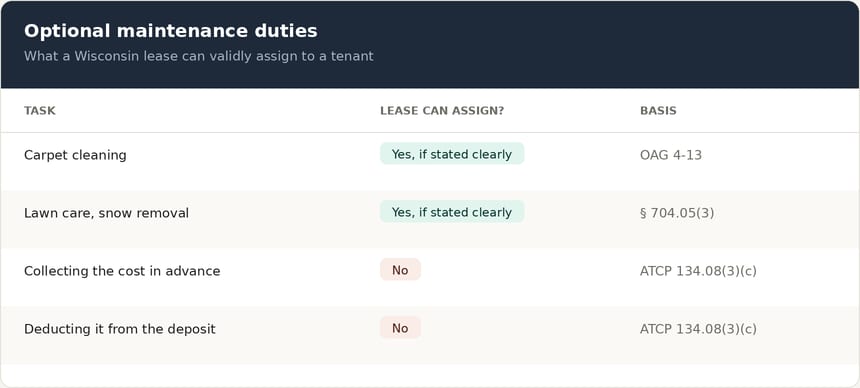
Landlords can lawfully assign tasks like lawn care, filter changes, or carpet cleaning to tenants, but only if the lease states them clearly. Even a valid clause can't be collected in advance or deducted from a security deposit.
An Attorney General opinion, OAG 4-13, confirms that carpet cleaning isn't a landlord's repair duty, which means leases can specifically require tenants to pay for routine cleaning.
Wis. Admin. Code § ATCP 134.08(3)(c) limits how that cost can be collected: any prepayment beyond one month's rent legally becomes a security deposit, and a landlord can't deduct routine cleaning costs from that deposit later, since normal wear and tear protections still apply.
A vague or undefined resident-charge clause creates real legal exposure for landlords, as leases must be written clearly to avoid litigation and correctly state those clauses. PAM's Variable Expense Ratio article covers how southeastern Wisconsin investors can write those clauses correctly.
Tenants who believe a resident-charge clause was mishandled can report to Wisconsin’s Department of Agriculture, Trade and Consumer Protection (DATCP), the state’s primary consumer protection agency. This includes tenants in the six counties that PAM serves: Milwaukee, Waukesha, Ozaukee, Racine, Washington, and Kenosha.
Can a Wisconsin Landlord Retaliate Against a Tenant Who Reports a Problem?
Wis. Stat. § 704.45 prohibits a Wisconsin landlord from raising rent, cutting services, or refusing to renew because a tenant made a good-faith complaint to government officials, housing agencies, or about the statute.
The one clear exception is that a property owner can take action on genuine, unrelated nonpayment of rent. Wis. Stat. § 704.44(8) reinforces this by voiding leases that waive habitability duties, which include keeping the structure and essential systems (heat, water, electrical, etc.) in reasonable repair and complying with local housing code.
This principle started with Dickhut v. Norton (1970), when the Wisconsin Supreme Court held that a tenant could assert retaliatory eviction as a valid defense after a landlord terminated the lease in response to the tenant’s complaint to health authorities about a Milwaukee housing code violation.
Wisconsin property owners cannot avoid basic maintenance obligations, even in writing. Together, these statutes protect tenants who want to have problems addressed and repaired in a reasonable timeframe. That protection only works, if someone actually invokes it.
Just as Jim didn’t go back to his landlord over the ductwork, some tenants fail to act on their rights and won’t always follow-up on the responsibilities of their landlords. Others know their rights and will act on unclear standards. Unlawful actions or clauses in a lease could waste a lot of time and money for an investor who hasn’t protected themselves.
Southeastern Wisconsin investors ready to treat their own lease as a compliance document can quickly audit leases against these sections and statutes to prevent future costly legal disputes. Schedule a lease audit with Jim to review tenant and landlord duties with an expert.