Furnished vs. Unfurnished: What Milwaukee Property Investors Should Know
Furnishing a Milwaukee, Wisconsin, rental can boost income in short-term and mid-term housing markets, but it adds real financial risk that first-time investors often overlook. Investors have to weigh the income upside against depreciation, damage, and turnover costs before furnishing any unit.
Jim Miller learned that the hard way. Decades ago, he signed a lease on a furnished studio apartment that would completely change his outlook. At age 18, going with a space with furniture seemed like the right thing to do, since he didn’t have a couch, bed, or dishes. But today he describes that experience plainly: “It was awful,” adding that the smell of the carpet alone stayed with him.
Even now, as the owner of Performance Asset Management (PAM), a property management business that has served residents across Milwaukee, Waukesha, Racine, Kenosha, Washington, and Ozaukee counties for 17 years, that memory still shapes how Jim evaluates furnished rentals.
Despite his experience, whenever an investor asks whether they should furnish a unit, Jim’s answer is never a simple yes or no. That decision involves financial modeling, and mistakes can be expensive to undo, especially once a resident has signed. Making that decision means considering the property type, tenant, and lease length before moving forward, while knowing the costs if the furniture, fit, or timing are wrong.
What Are the Advantages of Furnishing a Rental Property in Milwaukee?
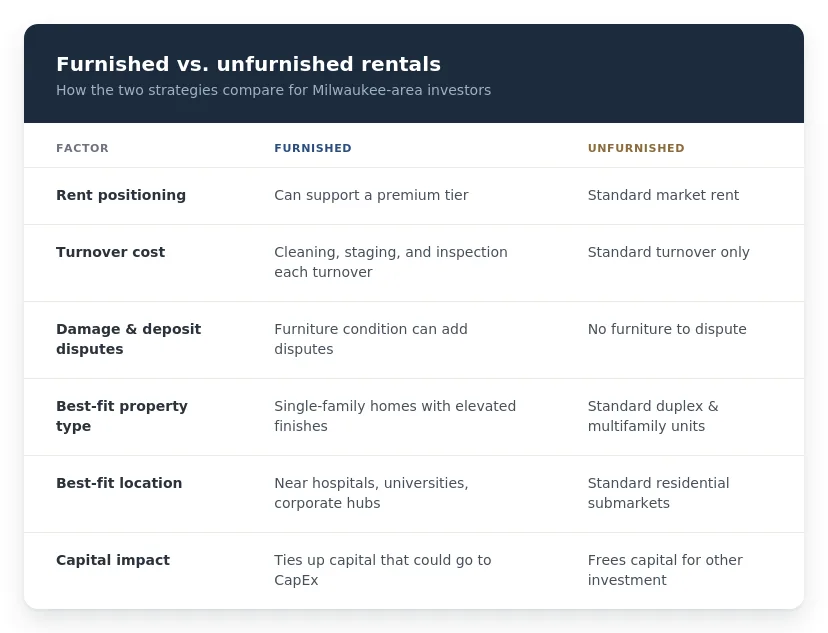
Furnished rentals in Milwaukee typically attract short-term, corporate, and relocation tenants who need move-in-ready housing immediately. This can position select properties in a stronger pricing tier than comparable unfurnished units nearby.
There’s no doubt about it: furnished units are appealing to renters who need to move in right away without the delay of furnishing. Residents relocating for a short period because of a job often seek furnished rentals. If elevated interior finishes are paired with quality furniture, that combination can push the unit into premium pricing.
Some Milwaukee submarkets, such as those near hospitals or universities, show strong demand for furnished rentals. “A property within a half mile of the medical college campus is checking multiple boxes, and that drives demand,” said Jim.
At times, corporate relocation can prioritize convenience over the savings of picking out furniture or shopping for details. A furnished rental can also reduce the vacancy periods if the investor can target residents seeking shorter leases.
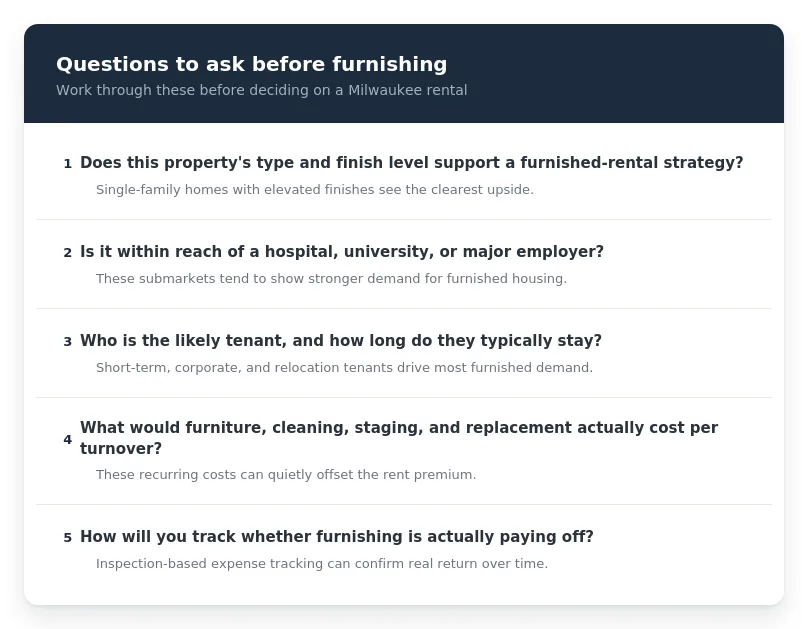
Investors with elevated finishes in single-family homes typically see the clearest upside from renting a furnished unit, as furnishing can also differentiate a listing in an otherwise crowded rental market. Despite the strong correlations, none of these advantages apply automatically. Each depends on matching tenant demand.
What Are the Risks and Hidden Costs of Furnishing a Milwaukee Rental?
Furnished rentals typically generate additional revenue, but the added furniture, maintenance, cleaning, insurance, and replacement costs often offset that benefit.
Regularly replacing furniture can quickly and quietly diminish the rental income furniture was expected to add. Property investors should understand that every turnover means cleaning, staging, and inspection work.
To further complicate things, some residents will initiate security deposit conversations over the condition of the furniture. Furniture damage may raise different questions than structural damage when it comes to security deposits.
Landlords may withhold security deposits for tenant damage, waste, or neglect, but not for normal wear and tear, according to the Wisconsin Department of Agriculture, Trade and Consumer Protection. Investors should discuss unusual furniture-related deductions with a southeastern Wisconsin attorney before withholding money from a security deposit.
Property investors new to the market can underestimate how quickly a furniture budget can add up. Another downside is that poorly maintained units can quickly hurt listing reputation. These hidden costs explain why furnishing isn't automatically the higher-return choice, as funds spent on replacing and repairing furniture also tie up capital that could go toward CapEx spending.
Which Milwaukee Properties and Tenants Make Furnishing Worth It?
Furnished rentals in Milwaukee typically perform better in single-family homes with high-quality finishes or in locations near hospitals, universities, and corporate employment centers.
This typically isn’t the case in standard long-term rental markets, where tenants prefer to bring their own furniture. For example, standard long-term duplex and multifamily markets are less likely to reward the expense of added furniture.
Location and resident demand can matter more than finishes alone. A beautifully furnished property will not necessarily command a premium if there is little demand for furnished housing in that area.
For example, a beautifully furnished home in a Milwaukee neighborhood dominated by traditional long-term renters may generate less additional rent than a simpler furnished unit located near major medical or employment centers where residents have a stronger reason to seek temporary housing.
Investors should also consider whether the property itself supports the furnished-rental strategy. A property with an open layout, quality finishes, dedicated parking, and convenient access to employment or medical centers may be easier to position as a furnished rental.
Investors should check the demand for fully furnished rentals before committing to the idea, in terms of asking rents, lease lengths, amenities, property size, and how the furnished properties differ from comparable unfurnished units.
Furnished or Unfurnished: How Should Milwaukee Property Investors Decide?
Milwaukee investors typically get the best results furnishing only when property type, tenant profile, and lease length all point toward short-term or mid-term stays. If these factors fail to align, furnishing can increase costs and risk without providing a return.
Advantages to adding furniture to a rental are real, especially in areas with market demand. For an investor, that means weighing furniture costs against lease length, tenant type, and exact location, earning more accurate projections than guessing net return.
The risks can include additional repairs or replacement costs. And investors who decide to furnish can use inspection-based expense tracking to confirm whether it’s actually paying off.
Investors can also rely on an experienced property manager to model furnished versus unfurnished income scenarios side by side by comparing projected rent, furniture and turnover costs, and expected vacancy time for each option.
By sharing the property location, resident applicant details, and lease length, investors across Milwaukee, Waukesha, Racine, Kenosha, Washington, and Ozaukee counties can consult with PAM before furnishing.