What Makes a Milwaukee Neighborhood Investment-Ready in 2026?
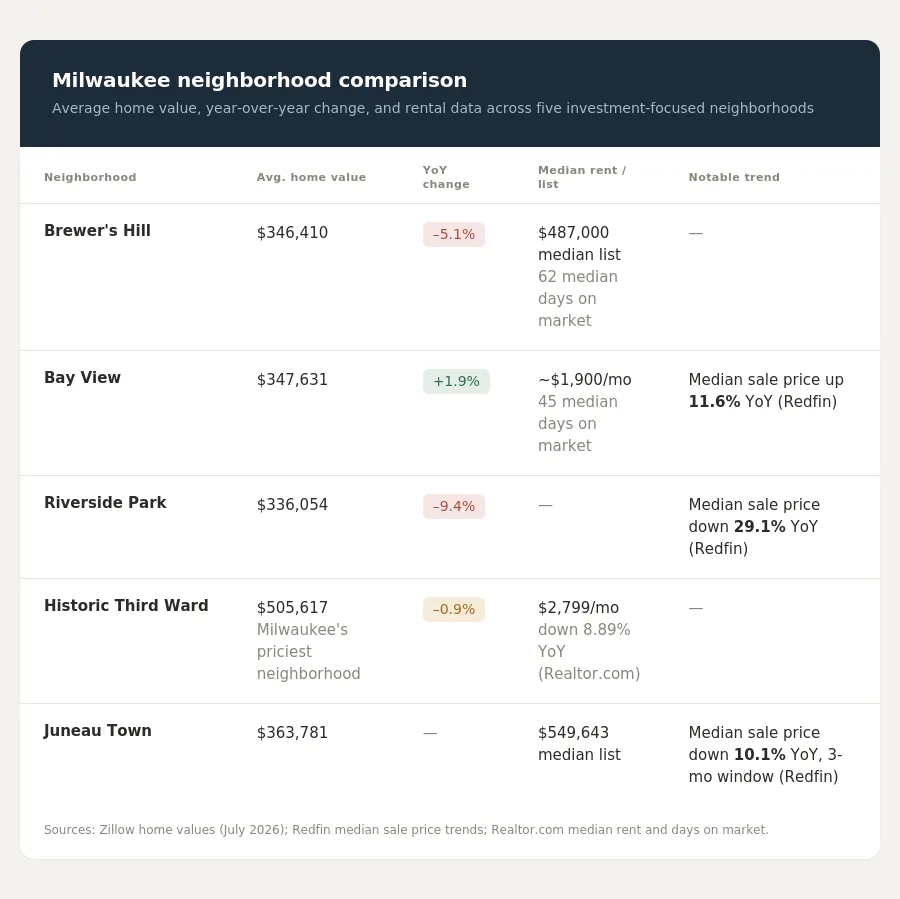
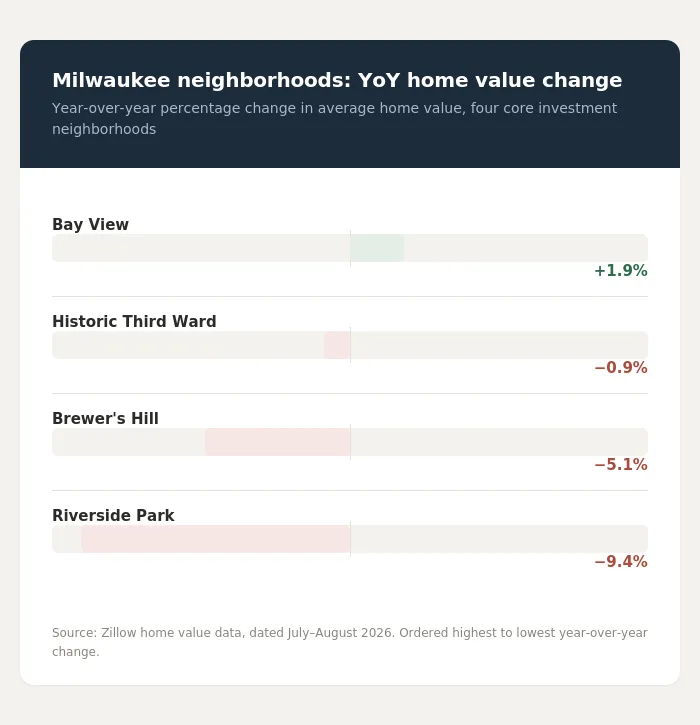
This year, the average value for a Milwaukee, Wisconsin, home climbed 3.3%. But individual neighborhoods swung wildly in comparison. Riverside Park dropped 9.4%, the Historic Third Ward slipped 0.9%, and Bay View climbed 1.9%, according to Zillow. The takeaway is simple: understanding property trends means honing in on distinct neighborhood patterns.
When a holding period and long-term goals align with price, rent, and resident type, that neighborhood is investment-ready. At Performance Asset Management (PAM), supporting investors means managing over 450 units in six counties, and that footprint gives PAM direct visibility into which specific blocks are actually performing.
Home values across Milwaukee's most-watched neighborhoods have moved in different directions over the past year, while rental demand in Southeastern Wisconsin remains strong. And property owners seeking a breakdown of five Milwaukee neighborhoods using verified, dated data can continue reading. Learn more about the gap between price and rental demand, where disciplined investors find opportunity.
Which Milwaukee Neighborhoods Are Performing Best for Investors Right Now?
Rental demand in Bay View has held up even as home values in nearby neighborhoods pulled back, according to July 2026 Realtor.com and Zillow data. Brewer's Hill, Riverside Park, Historic Third Ward, and Juneau Town each tell a different story, as the table below shows.
Different Milwaukee neighborhoods each have a unique trajectory, even though the Milwaukee market is advertised as hot. Treating citywide averages as context helps property investors avoid mishaps and encourages block-level due diligence.
How Should Milwaukee Property Investors Evaluate Neighborhoods Beyond Median Home Price?
Property investors should judge Milwaukee neighborhoods by features like walkable green space and off-street parking that consistently attract longer-tenured, more reliable residents.
Listing price fails to consider interior finishes in a premium home versus ten-year-old carpeting that looks unappealing online and even worse in person. Even though modern consumers typically evaluate potential homes online before viewing in person, two duplexes that look identical online can command different rent prices, and that difference can easily be $100-$500.
In Southeastern Wisconsin, single-family homes offer more pricing flexibility than duplexes simply because of limitations on inventory. That scarcity lets well-positioned single-family owners test higher rent before settling into market rate. Overall neighborhood quality is also a major factor for residents and influences whether they re-sign.
PAM has a resident placement process that weighs affordability and stability because the best neighborhood must also match the resident. And residents who stay over 36 months eliminate many of the turnover costs that reduce investor returns. Taking steps to evaluate Milwaukee neighborhoods ensures that investors stay grounded in verified local demand data.
Which Milwaukee Housing Segments Are PAM Monitoring the Closest?
PAM Owner Jim Miller points to Milwaukee's established single-family and duplex neighborhoods over newly built downtown towers, where occupancy has struggled.
Occupancy rates in three recently constructed buildings in downtown Milwaukee remain below 40%, said Jim. That underperformance sits well behind the neighborhoods PAM actively manages across six counties.
National and citywide vacancy rate reports can make stable neighborhoods appear weaker than they really are, especially when comparing new construction to established areas.
Nearby single-family and duplex properties operate differently than downtown towers. Investors chasing "new and shiny" may end up competing against buildings still trying to fill up.
A well-located older duplex faces little of the downtown leasing pressure that those towers do. Investors evaluating any Milwaukee neighborhood should ask what's actually driving a reported vacancy number. A manager unaware of that distinction may steer an investor away from a genuinely stable block.
How Does Neighborhood Choice Affect Long-Term Rental Returns?
Long term investor interests are better protected when the right resident and an appropriate rental strategy paired with the right neighborhood and a proven lease renewal process.
Choosing the right neighborhood pays off best when that choice is paired with disciplined lease renewal steps that achieve high rates. For example, PAM's lease renewal rate reached 88.76% as of May 2026, and this number is above many industry averages, which range from 50%-60%. That performance protects net operating income regardless of the neighborhood.
Unlike other markets in the United States, southeastern Wisconsin remained stable, amid recent national trends that showed declines. For more information, read Declining Rent Trends Across America: What Investors Should Know. That stability makes neighborhood selection a long-term decision.
Investors who pair strong location fundamentals with a manager who prioritizes resident placement can avoid losing 10% to 25% of annual NOI. Property owners evaluating Milwaukee neighborhoods to invest in should request current Comparative Market Analysis data, because neighborhood appreciation potential fails to offset losses from poor resident placement.
PAM has served southeastern Wisconsin investors for over 17 years. Bring an address for the renewal, CapEx, and rent-range math directly. Schedule time with Jim Miller to discuss which neighborhood fits best.