What Happened to BlackRock and Morgan Stanley's Funds?
BlackRock and Morgan Stanley both limited investor withdrawals in 2026 after redemption requests exceeded their existing quarterly limits, according to fund disclosures and reporting from major news publications, which surfaced earlier this year. Property investors know that tighter liquidity and changing credit conditions can impact the availability and cost of financing.
BlackRock’s HPS Lending Fund received redemption requests equal to 9.3% of shares outstanding. The fund's existing quarterly repurchase limit was 5%, so it could not fulfill the full amount of the requested redemptions. Similarly, Morgan Stanley’s North Haven fund reported redemption requests equal to 10.9% of shares outstanding, exceeding its existing 5% quarterly repurchase limit.
For over 17 years, Performance Asset Management (PAM) has tracked market shifts for southeastern Wisconsin investors across six counties: Milwaukee, Waukesha, Racine, Kenosha, Washington, and Ozaukee. Instead of reacting to headlines, investors can track days-on-market, rental demand, vacancy, inventory, and debt-service coverage.
Why Are Private Credit Funds Restricting Withdrawals?
Private credit funds are structured for long-term lending, so limits are set on how much people can withdraw. When withdrawal requests exceed caps, limits are enforced, as BlackRock and Morgan Stanley did in 2026.
Withdrawal limits are hardly new to the private credit market. These long-standing benchmarks were put in place to encourage structure. Investors who assume these limits were newly invented in response to current market stress would be wrong. For these funds, which are structured as interval funds or business development companies, this distinction matters:
The 5% quarterly cap has always been part of the design. The nuance is that these caps are actually binding. For over a decade, the cap was rarely tested. People who wanted to withdraw did just that. Things changed in 2026 when withdrawal requests exceeded the limit. Although the number was pre-existing, the cap activated for the first time at a significant scale.
For most southeastern Wisconsin investors, this distinction matters only indirectly. Local financing typically runs through community banks and credit unions, which is worth keeping in mind when refinancing an existing property.
Will Private Credit Withdrawals Impact Southeastern Wisconsin Property Investments?
Southeastern Wisconsin is unlikely to see the same effects as markets in other parts of the country that have experienced multi-year construction booms linked to private investments.
HUD's latest Milwaukee-Waukesha market analysis supports that distinction. Multifamily units under construction fell from 4,200 to 2,975 over the year ending in the third quarter of 2025, while multifamily permitting declined from 2,275 units to 1,525 in the 12 months ending August 2025. HUD characterized the apartment market as balanced, with a 5.1% vacancy rate, while three-bedroom single-family rentals saw rents rise 2%, according to HUD PDR&R Housing Marketing Profiles.
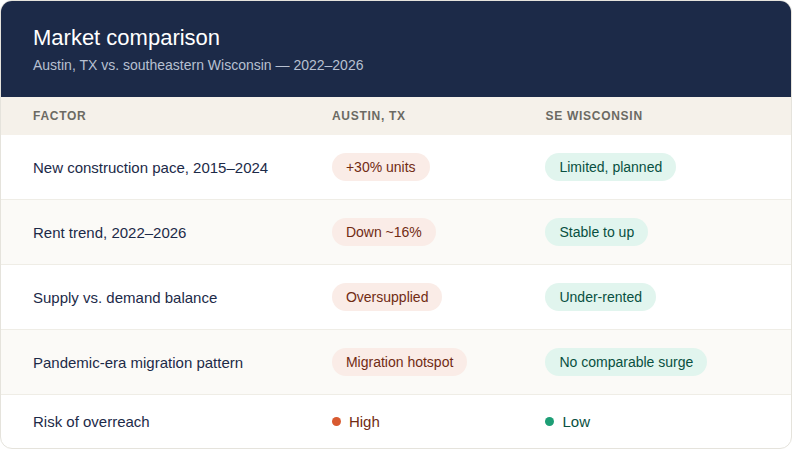
Because southeastern Wisconsin rental markets grew steadily on conservative lending, that structural discipline is why the region hasn't seen a comparable rent decline. This is different from markets in some Sun Belt metropolitan areas, which have experienced well-documented apartment rent declines since 2022.
Austin went down roughly 16% from its 2022 peak, largely tied to overbuilding, according to a Multi-Housing News report. Between 2015 and 2024, developers added 120,000 units to Austin's inventory, marking a 30 percent growth, more than three times the national average increase of 9 percent, reads the Multi-Housing News report.
It is uncertain whether the overbuilding was financed by the same or similar private credit funds currently facing withdrawal pressure. The two are best understood as related but separate market stories.
Southeastern Wisconsin never became a pandemic-era migration destination the way Sun Belt metros did, and its small multifamily and single-family assets grew steadily on conservative lending practices.
Commercial diversification across the suburbs further stabilizes the local market, making southeastern Wisconsin an area built for more consistency.
What Can Wisconsin Property Investors Learn from the Private Pressure?
Evaluate markets on fundamentals like days-on-market and inventory trends. Markets that stay structurally under-rented, like Southeastern Wisconsin, carry less overreach risk regardless of major events in national credit markets.
Southeastern Wisconsin investors who want to track local demand are better suited to review days on the market and vacant-unit inventory. By comparing market inventory for the current month to the same month two years prior in each category, investors can access more accurate and relevant market information that supports better long-term decision-making.
Strong rental markets tend to have steady demand and limited new supply. Investors can favor markets that remain structurally under-rented over those that show clear signs of overbuilding. Because of these features, investors shouldn’t assume that national credit market headlines apply across every local market.
How Does PAM Apply This Same Discipline for Investors?
PAM applies the same discipline that has kept Southeastern Wisconsin insulated from national market swings: real-time data, conservative pricing, and a focus on lease renewal over speculative growth assumptions.
Although news headlines may point to problems across rental markets, local demand consistently exceeds available supply across duplex and single-family homes in southeastern Wisconsin, according to PAM leasing data, making the region well-suited to consistent growth. PAM chooses to work in disciplined, under-rented markets, protecting investor interests.
For more information on how the leasing team at PAM tracks daily and weekly performance data that individual investors struggle to isolate independently, schedule a meeting and get answers to tough questions, backed by hard data.